Crown thinning, deadwooding, canopy raising and palm work — pruned to ANSI A300 standards by a veteran-owned crew that knows the difference between a cut that helps a tree and one that shortens its life. Every branch hauled away, every quote in writing.
Tell us what needs cutting back. An estimator calls to schedule a free on-site walk-through.
Trimming
Bringing a canopy back off the roofline, lifting limbs above the driveway, tidying an overgrown silhouette. The goal is how the tree fits its space — appearance, sightlines and clearance from what's around it.
Pruning
Selective removal of dead, diseased, crossing, rubbing or poorly attached limbs. Cuts are made at the branch collar so the tree can compartmentalize decay and gradually close over the pruning wound. them, and the aim is a stronger branch architecture that holds up over decades.
Thinning
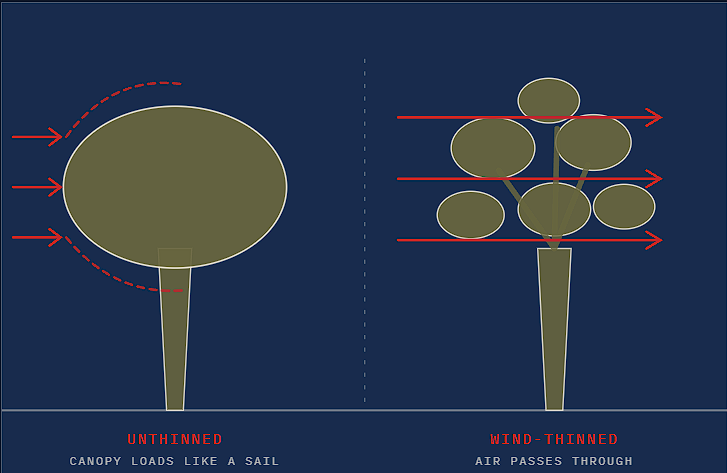
Removing a measured share of interior growth so wind moves through the canopy rather than pushing against it. On the Gulf Coast this is the pruning that matters most, and it has to be finished before storm season, not during it.
>
Interior branches come out, the outline stays. Thinning works from inside the canopy. Done right, the tree keeps its natural shape and nobody can tell it was pruned — it just moves differently in wind.
>
Deadwood goes first. Dead limbs have no flex left in them and are the pieces most likely to break loose and become projectiles.
>
Weak attachments get addressed. Included bark, tight V-crotches and co-dominant leaders are where mature trees split. These get reduced, removed or cabled before a storm finds them.
>
End weight comes off long limbs. Shortening heavy laterals back to a suitable branch reduces leverage on the attachment point without topping the tree.
>
No more than about a quarter of the live canopy. Over-thinning starves the tree and triggers weak watersprout regrowth — the opposite of what you paid for.
Every cut has a name and a reason. Here’s what the estimator will be recommending, and what each type is actually for.
Selective removal of interior branches to increase light penetration and airflow. The go-to service before hurricane season, and the one that makes the biggest difference to how a tree handles wind.
Removing dead, dying and diseased limbs throughout the canopy. Improves safety immediately, reduces entry points for decay and insects, and instantly makes a tree look healthier.
Lifting the lower canopy to clear roofs, driveways, walkways, signage and sightlines. Done gradually so the tree isn't stripped of the lower limbs that support trunk taper.
Reducing height or spread by cutting back to a suitable lateral branch that can take over as the new leader. This is the correct way to make a tree smaller — and it is not topping.
For young and semi-mature trees. Establishing a single dominant leader and well-spaced scaffold limbs now prevents the co-dominant splits that take trees apart twenty years later.
Limbs off the roof, out of the gutters, away from siding and clear of service drops. Branches resting on shingles trap moisture and give rodents and ants a bridge into the attic.
Sabal, queen, washingtonia, coconut and date palms — dead fronds, seed pods. Green fronds stay, because they feed the palm and shield the growing bud.
Opening a view to the water or the sky without gutting the tree. Careful, limb-by-limb work that keeps the specimen looking natural rather than carved.
Broken limbs, hangers caught overhead and torn attachments cleaned up and cut back properly so the wound can seal. Bigger jobs move to storm cleanup.
Topping means cutting main limbs back to stubs, with no regard for where the cut lands. It is the most damaging thing that can be done to a mature tree, and the arboriculture industry has rejected it for decades — yet it is still the cheapest, fastest thing an unqualified crew can sell you.
Here’s what actually happens. Removing that much leaf area at once starves the tree. The large stub wounds can’t seal and become decay entry points. The tree responds with a panic flush of watersprouts that are attached only to the outer layer of wood — so within a few years you have a denser, heavier, weaker canopy than before, held on by attachments that fail readily in wind. Topping does not make a tree safer in a hurricane. It makes it more dangerous, and it commits you to re-cutting it every few years.
The same applies to the palm “hurricane cut” — stripping fronds back to a narrow vertical plume. It removes the palm’s food supply, exposes the growing bud, and there is no evidence it helps in a storm.
When appropriate for the species and condition, crown reduction can reduce height or spread without topping. It shortens limbs back to a lateral branch large enough to assume the terminal role, so the tree keeps a natural form and a functioning canopy. It takes longer and costs more. It’s also the only version that works.
Dead, damaged and hazardous limbs come off whenever you find them — there’s no wrong season for safety work. For everything else, timing changes how well the tree responds.
Late winter – early spring
Structure is visible without leaves and the tree compartmentalize decay and gradually close over the pruning wound quickly as growth resumes. Live oaks, water oaks, maples and elms all respond well here.
Finish before June
Hurricane season starts June 1. Thinning and deadwood work should be complete before then — not scheduled once a storm is already named.
Right after flowering
Species that flower on old wood set next year’s buds soon after blooming. Prune too late and you cut off the coming season’s flowers.
Any time, lightly
Remove fully brown fronds and seed pods as they appear. Avoid heavy stripping year-round — green fronds are the palm’s energy source.
Every 2–3 years
Small corrective cuts while limbs are still small set the permanent branch structure. This is the cheapest pruning you will ever pay for.
Immediately
No seasonal restriction. If a limb is dead, cracked or hanging, waiting only increases the chance it comes down on its own terms.
Branches touching or overhanging the roof. Limbs low enough to hit a vehicle or block a walkway. Bare grey deadwood visible in the upper canopy. A canopy so dense you can’t see daylight through it. Growth crowding a service drop. Crossing limbs rubbing the bark off each other. A visibly lopsided crown pulling the tree to one side.
Any one of those is worth an assessment. Several together usually means the tree hasn’t been touched in a decade, and catching up will take more time than staying on a cycle would have.
Worth knowing: Routine structural pruning can reduce the need for more extensive corrective work later.
Height and spread set how much of the job happens on a climbing line versus from the ground. Access decides whether a lift can reach the tree or the crew climbs it. Species matters — a live oak with heavy horizontal laterals is slower work than a pine.
Time since last pruning is the factor people underestimate. A canopy on a three-year cycle is a quick visit. A canopy untouched for fifteen years is a rebuild, and it may need staging across two seasons so the tree isn’t over-cut in one go.
Every job is quoted in writing after an on-site look. The quote is itemized, cleanup is already in it, and the number doesn’t move once work starts.
Removal is obvious — the tree is either down or it isn’t. Bad pruning hides for years before it shows up as decay, weak regrowth or a failed limb. That’s exactly why it’s worth caring who does it. Meet the crew →
Every cut lands just outside the branch collar — not flush to the trunk, not leaving a stub. That's the only geometry a tree can actually seal, and it's the single clearest tell of a crew that knows what it's doing.
Undercut, relief cut, then the final cut at the collar. Skipping this is how limbs tear a strip of bark down the trunk on their way off, leaving a wound the tree may never close.
Spikes are for removals. Driving gaffs into a tree you intend to keep leaves puncture wounds all the way up the trunk. We climb on rope and saddle or work from a lift.
Licensed, bonded, and carrying liability and workers' compensation. Certificates are available before work starts. An uninsured crew in your canopy makes their injury your problem.
Free written estimate, no obligation, cleanup included. The calendar fills fast once the first storm is named — book the assessment early.
Veteran-owned tree services – Insured tree service serving Niceville, Destin and Fort Walton Beach at a fair price.
© 2026 Brothers in Arms Tree Services. All rights reserved.
Niceville · Destin · Fort Walton Beach