Brothers in Arms is the veteran-owned crew Northwest Florida trusts for tree removal, trimming, stump grinding, and 24/7 storm response — every job quoted up front, executed safely, and cleaned up completely.
01
A tree that stays bare while everything around it flushes green is dead or dying. Dead trees dry out, get brittle and shed limbs without warning — and they only get more dangerous to remove the longer they stand.
02
Shelf fungus on the trunk or fruiting bodies in the root flare mean internal decay is already well established. The outer wood can look perfectly sound while the structural core is gone.
03
Tap it and you get a drum sound instead of a dull thud. Some hollowing is survivable; once decay passes roughly a third of the trunk's radius, the tree can no longer be trusted near anything you care about.
04
Trees that have always leaned are often fine. A lean that appeared after a storm — especially with cracked or heaving soil on the opposite side of the base — means the root plate is failing. That one is urgent.
05
Bare grey limbs in the upper canopy are the ones that come down in a squall. If deadwood is scattered throughout rather than confined to the lower interior, the whole tree is in decline.
06
Healthy bark stays put. Loose plates falling away to expose smooth wood underneath — often with beetle galleries etched into it — indicate the tree stopped moving water a while ago.
07
Roots lifting a driveway, limbs on the roof, a sand pine towering over the pool deck. Sometimes the tree is healthy and still has to go, and that is a perfectly good reason to remove it.
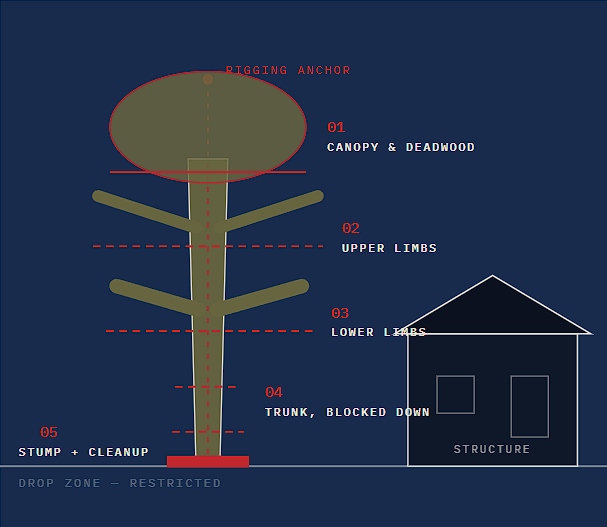
Felling a tree in one piece needs a clear drop zone twice its height. In most Northwest Florida yards that space doesn’t exist — so the tree gets dismantled from the top down, one rigged section at a time. Here’s the sequence we brief before the saws start.
01
The crew walks the site, identifies the drop zone, sets a climbing line and establishes an anchor point above the work. Nothing is cut until everyone knows where each piece is going.
02
A climber or lift operator works from the top, clearing deadwood and small-diameter growth first. This lightens the tree before any load-bearing wood is touched.
03
Larger limbs are tied off, cut, and lowered under control on the rigging line rather than dropped. This is the step that keeps weight off the roof, the pool cage and the fence.
04
The remaining spar is cut into manageable blocks and lowered in sequence until the stem is at ground level — leaving a low, flat-cut stump.
05
Optional stump grinding below grade, then every branch and chip is loaded out and the ground is raked clean. The yard should look better than it did when we arrived.
One crew, one standard, whether it’s a single palm in a courtyard or a stand of storm-shattered pines across an entire lot.
Standing deadwood is unpredictable and brittle, which makes it more dangerous to remove — not less. We take these down with rigging rather than felling, and we don't wait for them to fall on their own.
Split leaders, hangers caught in the canopy, uprooted trunks resting on a roof. Loaded and bound wood carries stored tension and is the most common way untrained people get hurt after a hurricane. Leave it to the crew.
Trees hemmed in by houses, pool cages, fences, sheds and neighboring property. Dismantled in sections and lowered piece by piece, with plywood and mats laid down to protect turf and pavers.
Anything contacting a primary conductor requires the utility to de-energize the line before work begins — we coordinate that first. Service drops and clearance work we handle directly, following OSHA approach distances.
Mature live oaks, water oaks, sand pines and slash pines with heavy lateral spread. These need real rigging capacity and a crew that has taken down hundreds of them.
Sabal, queen, washingtonia and coconut palms — including root-ball extraction where you plan to replant or re-sod. Palms are deceptively heavy for their diameter and behave nothing like hardwood.
Overgrown acreage, build-site prep and shoreline clearing. If the job is more clearing than removal, our service is usually the better fit — the estimator will tell you which.
Tree on the house, driveway blocked, a limb pinned against a service line. The line is answered around the clock and crews roll day, night and weekends across Northwest Florida.
The single most common complaint about tree companies is a bill that grew after the work started. Here is exactly where the line sits, in writing, before anything is scheduled.
Anyone quoting a firm price over the phone hasn’t seen the tree. Six variables set the number, and they compound — a tall tree is one thing, a tall tree ten feet from a pool cage with no gate access is another entirely.
Height sets the rigging system and the time on the line. Spread sets how many separate pieces have to come down. A 70-foot pine and a 70-foot live oak are very different jobs.
The biggest hidden variable. If a chipper and truck can back to the tree, the job is efficient. If everything has to be carried through a side gate by hand, labor hours climb sharply.
Open yard means sections can be dropped. A roof, pool cage, fence, septic field or neighbor’s shed underneath means every piece gets tied off and lowered — slower, and it requires more skill.
A sound, healthy tree is predictable to climb. Decayed, hollow or storm-loaded wood can’t be trusted to hold a climber or a rigging load, so it often needs a lift or crane instead.
Stump grinding, root removal, hauling out an existing brush pile, or grade and sod repair. Each is quoted as its own line so you can add or drop it.
In Florida it depends on where the property sits, what species the tree is and how big around it is. Rules inside city limits are frequently stricter than in unincorporated county land, and protected species and heritage-size specimens often carry their own requirements on top.
There is one important exception worth knowing: Florida law limits what local governments can require when a ISA Certified Arborist or Florida-licensed landscape architect has documented that a tree presents a danger to people or property. Documentation matters, so keep everything.
Practically speaking — we tell you at the estimate whether your removal is likely to need a permit, what the local authority usually asks for, and whether a hazard assessment is worth having in hand. Confirming with your municipality before work begins is always the right final step.
The general pattern: if a tree has fallen on a covered structure — house, garage, fence, screened enclosure — most homeowners coverage may apply when a fallen tree damages a covered structure; confirm coverage and debris-removal limits with your carrier. to removing it and repairing the damage. If a tree comes down in an open yard and hits nothing, or if you’re removing a healthy tree as a precaution, that is usually out of pocket.
Coverage limits for debris removal are often capped well below the full cost of a large job, so read the policy rather than assuming. Your carrier is the only one who can tell you what applies.
What we can do is make the claim easier: itemized written documentation, before-and-after photos, and a clear description of the damage and the work performed. Ask the estimator and it comes standard.
Owners Danny and Tyler met in the United States Air Force. When they traded uniforms for chainsaws they kept the parts that mattered — brief the plan, execute safely, leave the site better than you found it. Read the full story →
Licensed, bonded and carrying both liability and workers' compensation coverage. Ask for certificates before work starts — we hand them over without being chased. An uninsured crew on your property makes their injury your problem.
Written, itemized, and it doesn't move once work begins. If we find something genuinely unforeseen inside a decayed trunk, we stop and talk to you before spending your money.
Rated rigging gear, correct PPE, established approach distances near conductors, and a drop zone nobody walks into. Discipline is the whole reason the work stays boring.
Full haul-away is part of the quoted job, not a line you discover afterward. See what that looks like in the before & after gallery.
Veteran-owned tree services – Insured tree service serving Niceville, Destin and Fort Walton Beach at a fair price.
© 2026 Brothers in Arms Tree Services. All rights reserved.
Niceville · Destin · Fort Walton Beach