
Tell us about the stump. An estimator calls back to schedule a free look.
A stump isn’t neutral. Left in a Niceville or Destin yard it keeps costing you — in pests, mower blades, resale photos and the sod that will never grow over it.
01
Subterranean termites are endemic across Okaloosa County, and a decaying stump with its root system is an ideal colony base. A stump ten feet from your slab is an invitation — and one of the strongest practical arguments for grinding in this part of Florida.
02
Carpenter ants, wood-boring beetles and armillaria root rot all colonize dead wood. The rot can spread through root contact to healthy trees nearby — the stump you ignored becomes the reason the next tree declines.
03
Laurel oaks, crape myrtles, Bradford pears and chinaberry send up sucker growth from a live stump for years. You don't get a lawn back; you get a shrub you have to keep fighting.
04
Stumps cut low disappear into grass. What finds them is a mower blade, a trailer tire, or a guest's foot — and a known trip hazard on your property is a liability question you don't need.
05
Nothing gets built, laid or planted over a stump — no sod, no pavers, no irrigation line, no fence post. Grinding is what turns the spot back into usable yard.
06
Buyers and appraisers notice stumps the way they notice a torn screen — small money, big signal. For the cost of one grinding visit the listing photos say "maintained" instead of "project."
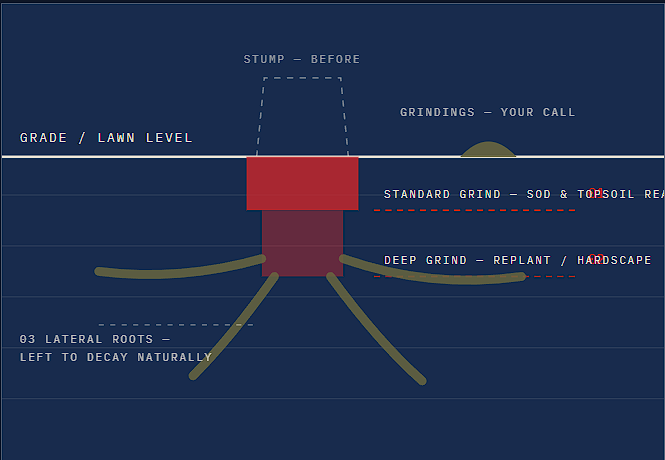
“Ground out” means different things depending on what the spot is going to become. This is the conversation the estimator will have with you, drawn to scale.
>
Standard grind — lawn ready. Several inches below grade: enough to spread topsoil, seed or lay sod straight over the top. This is the right depth for most jobs and the one most companies quote by default.
>
Deep grind — replanting or hardscape. If a new tree, an irrigation run or pavers are going in the same spot, the grind goes deeper and the grindings come out of the hole. Chips left in the soil tie up nitrogen as they decay, and new roots struggle in them.
>
Lateral roots stay — and that's correct. The root system decays naturally over a few years. Digging it all out means an excavator, a crater and a torn-up lawn, which is why full extraction is reserved for construction footprints.
>
Grindings, three ways. Raked back and mounded to settle level, hauled off and backfilled with soil, or piled for you to use as mulch. Quoted separately so you only pay for the version you want.
>
Sunshine 811 is contacted before every stump-grinding job. Customers should also identify private lines and systems on the property that 811 does not normally locate.
A carbide cutter wheel chips the stump down below ground level, on site, in place.
An excavator digs and pulls the entire stump and root ball out of the ground.
Grindings and soil; lateral roots decay naturally underground over a few years.
A large crater needing significant backfill, plus equipment tracks across the yard.
Minimal — the machine reaches the stump, grinds, and leaves.The timing for new sod depends on chip removal, backfill and soil settling.
Substantial. Surrounding turf, beds and irrigation usually need repair afterward.
The affordable option, and cheaper again when bundled with a removal.
Lawns, beds, replanting, pavers, fence lines — effectively every residential situation.
Diameter is the big one — measured across the widest point of the root flare at the ground, not the trunk you remember. A stump always measures bigger than the tree looked. Depth adds time if you’re replanting. Surface-root grinding may be available for roots from the removed tree. Structural roots belonging to a living tree should not be ground without a qualified assessment.
Access matters the same way it does for removals: a stump behind a pool cage that only a small machine can reach through a gate takes longer than one the big grinder can drive to. Count works in your favor — each additional stump on the same visit costs far less than the first.
Hardwood stumps — the live oaks and water oaks all over Niceville — grind slower than pine. Every job gets a free written quote before anything is scheduled.
The cheapest time to grind a stump is the day the tree comes down. The crew is already on site, the equipment is already loaded, and the mobilization cost is already paid — which is why grinding booked with a tree removal is discounted.
Booked separately later, the same grind costs more, because a machine and operator make a dedicated trip. If you’re on the fence at removal time, have it quoted as a line item — you can see exactly what the bundle saves and decide with the numbers in front of you.
Already have old stumps from a removal years ago? That’s the other common call, and it’s worth grouping them: one visit for three stumps beats three visits for one.
Area of operations
Three cities, one crew, and a grinder sized for each situation — from open Niceville lots to gated Destin courtyards.
32578 · Priority response
Big hardwood country — live oak and water oak stumps here run wide at the flare and grind slow, and the wooded lots off Rocky Bayou often have several stumps worth grouping into one visit. Surface-root grinding is a frequent add-on under mature canopy.
32541 · 32540 · Home base
Tighter coastal lots where access decides the machine: plenty of Destin stumps sit behind pool cages and garden gates, so we bring the narrow grinder where the big one can't pass. Palm stumps — fibrous, not woody — get handled differently, and we quote them accordingly.
32547 · 32548 · 32549
Established neighborhoods with decades-old shade trees mean old, hard, seasoned stumps — the kind a rental-yard grinder bounces off. In-town lots also put utilities and irrigation close to the work, so locating before grinding matters most here.
Free written estimate across Niceville, Destin and Fort Walton Beach. Grouping several stumps? Even better — the per-stump price drops.

Veteran-owned tree services – Insured tree service serving Niceville, Destin and Fort Walton Beach at a fair price.
© 2026 Brothers in Arms Tree Services. All rights reserved.
Niceville · Destin · Fort Walton Beach